The rise of new sovereign powers: the Tether dark horse
Tech eroding state power and our search for the new sovereigns
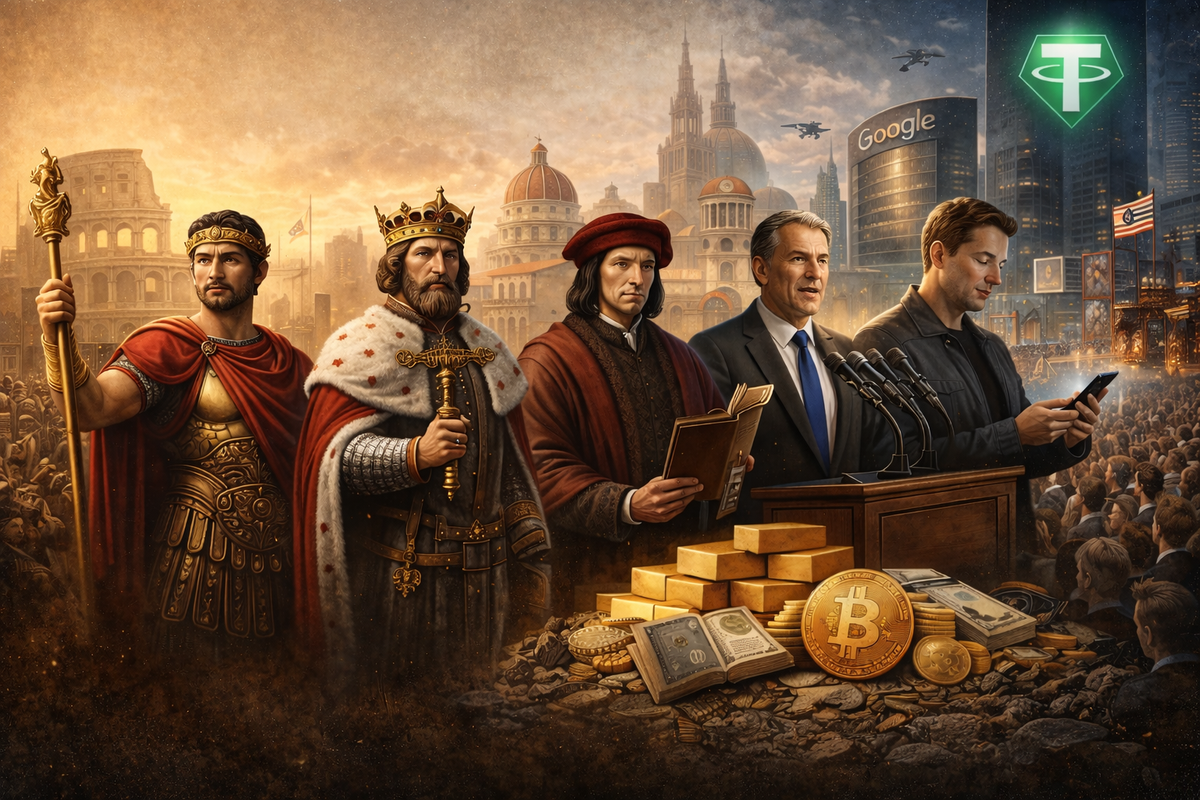
As readers might know, I've been thinking about the post nation state order quite a bit recently.
My view is that the crumbling of nation states is inevitable in the coming centuries.
But that's clearly the easy part. The most interesting question to ask with that view in mind is obviously: what comes next?
For a while, I've been stuck thinking about new governance structures, what would be the ideal government - and so on. But that has always felt like a very philosophical undertaking and very little like a proper real world discussion.
Recently I've started shifting my thinking more towards what actually matters in the world: power.
Today, nation states hold the power. They have their monopoly on violence controlling police and armed forces, they make the laws, and so on - but obviously the number one thing, that often most people forget, is that they print the currency, own the gold, own the infrastructure and so on. Like any respectable cartel, they're only as powerful as they're rich and can therefore pay their various armies, literal ones and bureaucratic ones. (A funny aside here is how their armies, especially the bureaucratic ones are becoming larger and larger and eroding the states' powers, hence our discussion which would likely not happen otherwise.)
So when we think of what comes after nation states the really interesting dynamic is who will have the money, and therefore the power.
The new sovereigns
The obvious candidates are the Mag7 tech companies: when you start thinking about how much of the state infrastructure they have already taken over in communications, mapping, data keeping, identity, and so on, it really starts to click. These will be the next sovereigns. They will keep on growing and they will keep on building (and owning) different pieces of the infrastructure.
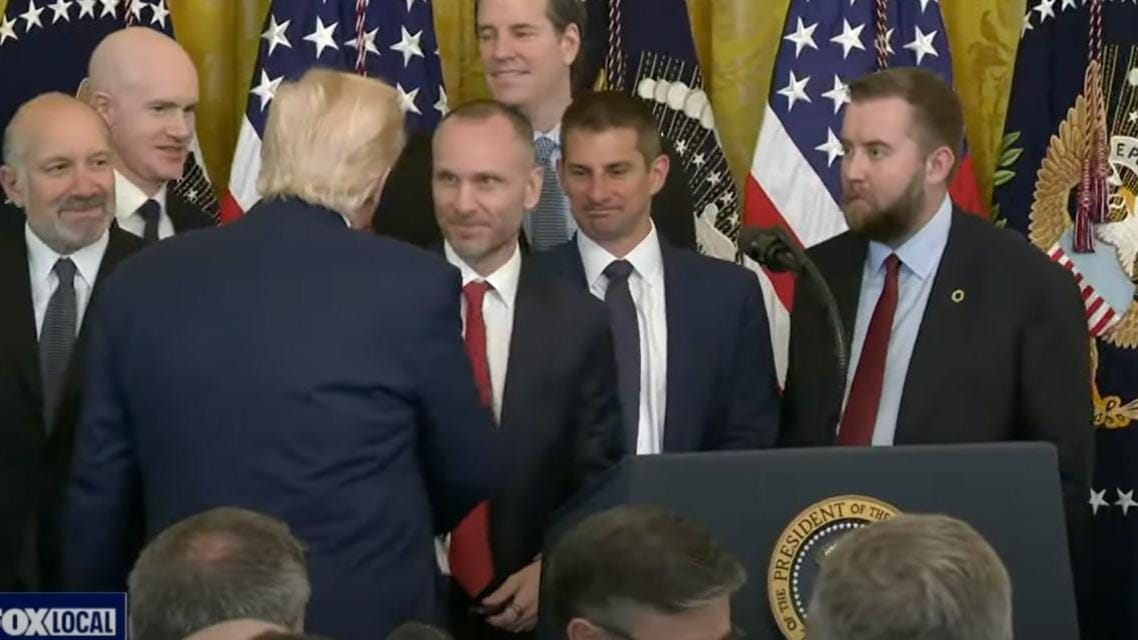
States won't be able to compete with the efficiency of tech companies, and you can already see how much they rely on them for national security concerns. All the important dinners at the White House now have way less people from Wall St., academia or the media, and are instead filled with tech people.

Think about it:
- World mapping is offered by Google
- Taxi services in towns are now offered by Uber (and soon by Waymo and Tesla)
- Worldwide internet access is now provided by a supranational entity: Starlink
- Global communications now happen on Whatsapp and similar apps
- Data storage is an Amazon and Mag7 exclusive
- Nothing happens without Nvidia chips
- AI will be all privately-owned
- there are even companies building physical infrastructure, like tunnels and ~rail
- and so on
This is now happening in defence as well, with Palantir and Anduril becoming key players on which nation states will have to rely more and more - not too hard to plot out that an Anduril will be dictating military policy. They already have removed state planning from military equipment, that's the next step.
The dark horse
But there was a dark horse that no one saw coming as a full sovereign candidate: Tether.
That faithful day when Giancarlo and Paolo decided to invent and launch the USDT stablecoin might end up changing the world much more than they and everyone else realized at the time.
Tether today:
- is the issuer of almost $200B worth of USDT.
- makes $15B in profit each year.
- has at least $200B in cash.
- owns more than 100k BTC (~$10B).
- spent more than $300M this year buying stakes in precious metals producers.
- owns $100B of US Treasuries.
- is the largest holder of gold outside of central banks (and bigger than a lot of those).
This is all quite incredible to believe for a small startup launched by two Italians and operating on the fringes of society (and public opinion) for the last decade [a good reminder for all the VCs that think the next applied customer service AI startup is the "future"].
You can project this out, and see how Tether will be in a pretty invincible position somewhat soon. Unless the FED brings down interest rates to negative levels (with all of its inflation consequences), Tether will continue to print profits at ridiculous levels for the next decades, all the while USDT continues to become the default currency in the developing world.
At the same time, Tether is already a major buyer of US Treasuries on par with Israel and Germany and can be projected to become an even bigger one. It only needs to 10x to become bigger than Japan.
Once you get that big, with the simple threat of shifting your buying power you can get actual, real world power.
Tether is already a multinational operation, not bound to any geographic place. It doesn't have any liabilities other than USDT redemptions, and it prints profit. It is what every state would want to be and will never be again: a surplus machine, with a ton of assets, and a growing (useful) basic service all around the world.
Nation states have completely failed in developing a just and fair financial system, and that has been the massive opportunity that Tether seized.
Another dark horse to watch out for is Strategy, who is now a credit-issuing business and could very well become a money-issuing business at some point. Saylor has an infinite level of ambition and I wouldn't be surprised to see him want to become a new sovereign.
Looking for the next sovereigns
It's true that it's hard to imagine anything more sovereignty-building than issuing world-adopted currency, but the failures of nation states are almost infinite and we can imagine other players will be able to erode their grasp on other aspects of life. Identity comes to mind, but policing, healthcare, and infrastructure build out will also be taken on by more efficient players.
What does a world like this look like? We obsess over this every week, so to anyone with concrete answers: please reach out and tell us your vision!
At Unruly, we are looking to find the next sovereigns. We want to understand who will develop basic infrastructure for the world, unencumbered by centuries of complexity, bureaucracy and corruption - and by so doing accumulate real-world power.
Expect to read more from your truly on how portable sovereignty changes world dynamics in a very real, and fast, way.
Unruly is looking for the next sovereigns, and invests in a world of shifting sovereign powers and rapidly declining populations.
Read our investment thesis on depopulation and what that means for the world.